Fremont History Articles
House History: the Braida House at 3408 Woodland Park Ave

The house at the corner of 34th & Woodland Park Avenue started out in 1901 as a simple one-story wood-frame residence. In 1915 the house was sold to Giovanni “John” Braida, an Italian immigrant who had lived in San Francisco before coming to Seattle. Braida was attracted to the business climate of Seattle where, as a marble and terrazzo artisan, he worked on tile inset entries for commercial buildings in downtown Seattle.
One of the first things Mr.
Alex Carter, House-mover in Fremont

In 1910 Alex Carter and his family lived in this house which he had moved to the site on 2nd Ave NW near 39th Street. Records show that he’d moved two houses and he may have cut one of them and added it onto the back of the other, to make more rooms. Mr. Carter lived with five women (Mr. Carter’s wife, mother-in-law and the Carter’s three daughters) so we can see that they needed more rooms,
Syvert Stray, Dairyman

In the early 1900s the Fremont neighborhood was home to many Scandinavian immigrants who worked hard in small businesses.
At age 17 in 1888, Syvert Stray from Norway began the classic immigrant journey, beginning in St. Paul, Minnesota, where he worked on a dairy farm. Mr. Stray migrated Out West to Seattle in 1902. He became owner of the Seattle Dairy company at the intersection of 8th & Union Streets, where the Seattle Convention Center is now.
House History: 911 North 36th Street

The Fremont neighborhood began to be settled in the summer of 1888 and many of the earliest houses were built in a cleared area along present-day Whitman and Aurora Avenues. We know that there must have been water resources there, because Fremont had no City water system at that time. Each house had to have access to its own well-water.
The house at 911 North 36th Street is one of the oldest houses that we know of in Fremont,
South of the Bridge: Then and Now

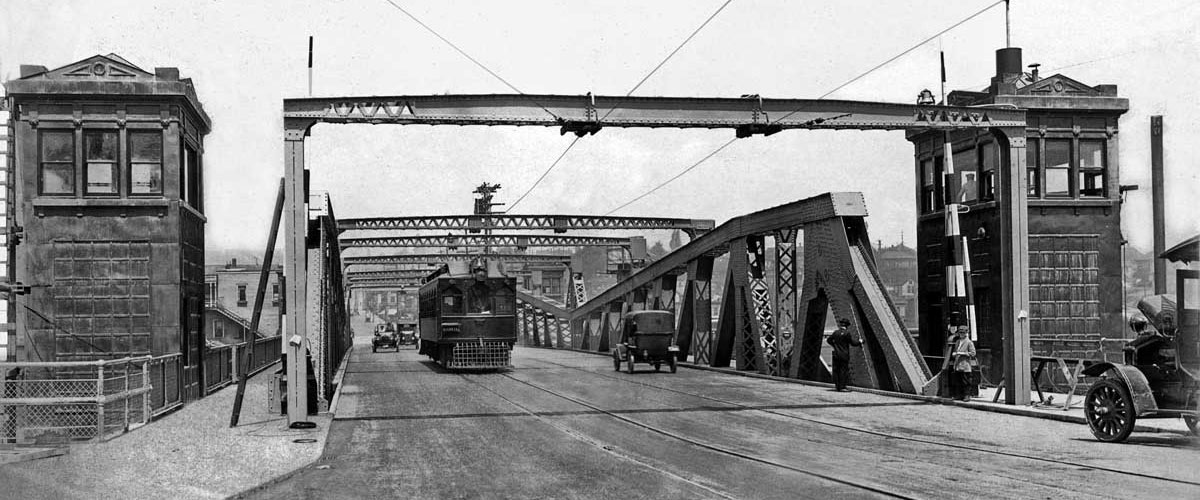
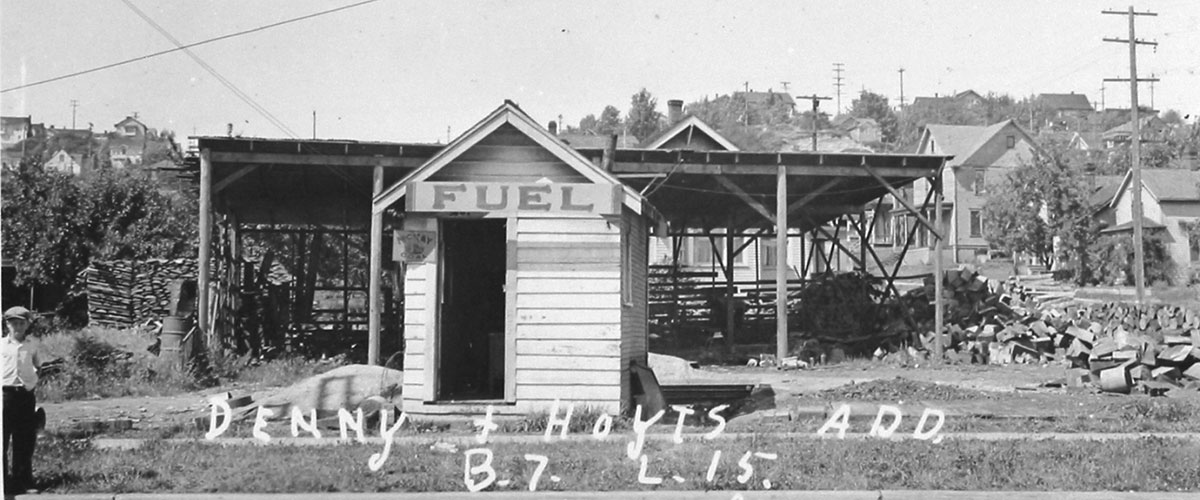
When the ship canal was completed in 1917, it created a change in the definition of the boundaries of the Fremont neighborhood. There had been a Fremont Bridge (over a small stream) before the ship canal and “Fremont” had included the area on the south side. The area as far south as Florentia Street, now on the south side of the bridge, was part of a plat called Denny & Hoyt’s which defined the original Fremont.
Stone Way in the 1930s: the 3500 Block

In the past twenty years Stone Way has been transformed from semi-industrial and construction-industry use such as electrical and plumbing companies, to a gleaming row of apartments and office buildings. Today the 35 Stone Office Building has replaced the old-time businesses in the 3500 block.
In the 1930s Fremont & Wallingford were already inside of the Seattle City Limits, and homes had electricity, but there was still use of coal, hay and kindling for woodstoves or fireplaces.
The lights are on again at the “Interurban.”

The Waiting for the Interurban statue is at the intersection of North 34th Street and Fremont Avenue. It memorializes the former rail line, called the Interurban, which went northward through Fremont to the city of Everett. This transfer point at the intersection, where City of Seattle streetcar lines also converged, did much to give Fremont the reputation of being the “center” of things, the Center of the Universe.
The Interurban statue was created by Richard Beyer in 1978.
The Hall of Giants: The Story of Fremont and the Troll

In 1990 the Fremont Arts Council sought proposals for a vacant area on North 36th Street which was directly underneath the Aurora Bridge. Immediately the folktale of the troll beneath the bridge came to mind, and this design proposal won acceptance.
The Fremont Troll became so popular that in 2005, the City of Seattle changed the name of the north-south avenue leading to it, to Troll Avenue. This made it much easier for visitors to Seattle to find the Fremont Troll.
Who was B.F. Day?

Benjamin Franklin Day was 45 years old when he and his wife Frances arrived in Seattle in the spring of 1880.
Born in Ohio, B.F. Day had farmed in Illinois, Iowa and Missouri. Biographical notes indicate that Day wanted to leave farming because of the hard physical labor. We don’t know why he chose to come to Seattle, but as a former farmer who had raised corn & hogs, B.F. Day would have known the importance of railroads in moving products to market. In the 1870s-1880s there was constant speculation about railroad routes across the USA.
The Burke-Gilman Trail in Fremont

The Burke-Gilman Trail, a walking-biking corridor which passes through Fremont, is the legacy of early Seattle movers-and-shakers, Thomas Burke and Daniel Gilman. The energy and activism of these men characterized the era of the 1870s-1880s when the population of Seattle began to grow and the city sought to make something of itself. Burke & Gilman transformed the city with their promotion of transportation projects.
Early Seattleites had already noted that there was a creek flowing westward from Lake Union through what is now Fremont and on out to Puget Sound.
C.P. Stone, Namesake of Stone Way

Corliss P. Stone was an early businessman, real estate investor, and civic activist of Seattle.
Stone was born in Vermont in 1838 and worked in what was called a dry goods store, meaning household supplies not including food. Some dry goods stores eventually evolved to sell clothing only.
As a young man Stone traveled to San Francisco to investigate the business climate and then he came to the Pacific Northwest. He worked for a time at Port Madison (north end of Bainbridge Island) which was the site of a lumber mill.
Fremont’s Northeast Corner: Porterfield’s Addition

Today the defined area of the Fremont neighborhood is bounded by 50th Street on the north, and Stone Way on the east. Fremont started in 1888 as a convenient streetcar neighborhood. Little stores sprang up at intersections of streetcar stops and transfer points, like this one at 4900 Stone Way.
Over time these streets have been expanded for car traffic and now are largely commercial areas. Today there is a Bamboo Village restaurant at this address,
Plats of Fremont

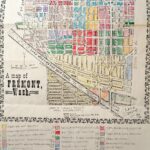
One of the ways to trace neighborhood history is by its land use, including plats of land laid out with streets and house lots. This map of the Fremont neighborhood in Seattle is marked with plats and their names.
The founding of Fremont in 1888 was in the area closest to the ship canal, although at that time it was only a small stream called The Outlet. The plat, which was named Denny &
The Sunset Heights Plat in Fremont
In 1871 in Norway, 21-year-old Oline Anrud married Hans Onsum, and the couple set out to start new lives in America. They touched down briefly in Wisconsin before continuing the westward journey to Seattle in Washington Territory.
In the 1870s and 1880s the couple spent some time in Seattle, where Hans had a meat market, and some time in rural Snohomish County. Perhaps Seattle’s Great Fire of June 6, 1889, made the couple decide that they would settle in the city where explosive population growth post-Fire,
House History: 4202 Phinney Ave North
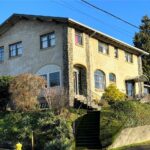
Captain Herbert E. Farnsworth made the classic Western migration of a Civil War veteran after the war. Born in New York State, after the end of the war in 1865, Captain Farnsworth married. The Farnsworth’s first daughter was born in New York and by the time of the birth of their second daughter in 1871, the family was living in the town of Kidder, Caldwell County, Missouri. It was a railroad town and Captain Farnsworth, who worked as a carpenter,
Fremont Public Art: Late for the Interurban

East of the Fremont Bridge on North 34th Street, near Adobe Plaza, Seattle’s favorite clown, JP Patches, and his friend, Gertrude, are forever “Late for the Interurban” in these bronze statues created by Washington sculptor Kevin Pettelle. The Interurban was the train to Everett with its transfer point by the Fremont Bridge, referenced by the Waiting for the Interurban statue there.
Installed in 2008 to commemorate the 50th anniversary of the J.P.
Fremont’s Streetcar Loading Platform

In 1927 a streetcar loading platform and cutoff route for cars was created at the intersection of Fremont Avenue North and North 34th Street. This intersection is familiar to us today as the site of the Waiting for the Interurban statue.
As car traffic increased in the 1920s it was found that when the city streetcar or the Interurban rail cars stopped to load passengers at North 34th Street, northbound auto traffic would back up onto the Fremont Bridge.
Fremont’s Grand Union Streetcar Switch

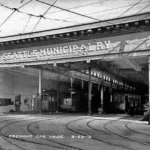
One of the reasons why Fremont was long regarded as the Center of the Universe was because of its convergence of streetcar lines. At the north end of the Fremont Bridge, in the spot where there is now the Waiting for the Interurban sculpture, there was a Grand Union track layout for streetcars to turn or go straight ahead, accommodating all the lines that passed through. The car barn for maintenance was located just west of here,
Fremont Public Art: The Berlin 1936 Crew Racer

The Data 1 office building at 744 North 34th Street was completed in 2017 and has outdoor artworks on each side of the building. At one side, underneath the Aurora Bridge, is a fragment of the Berlin Wall which tells of the triumph of the human spirit when Communism fell in 1989.
At the other corner of the Data 1 building (on the left as you look at it) is a metal sculpture of a man holding an oar,
Fremont Public Art: The Berlin Wall Fragment

The Berlin Wall divided East and West Germany and was torn down by its citizens on November 9, 1989, during the collapse of dictatorial rule of the Communist countries of Eastern Europe. We remember this significant historical event at the Berlin Wall and what it represents, the freedom of self-rule.
The Berlin Wall was completely demolished at that time, and fragments were carried away as mementos. The fragment which has been installed as public art in Fremont,
Fremont Public Art: The Lenin Statue

In 1981, the Communist Party of Czechoslovakia commissioned Bulgarian sculptor Emil Venkov to create a statue that portrayed Vladimir Lenin as a bringer of revolution. Briefly installed in Poprav, Czechoslovakia, the 16-foot bronze statue was sent to a scrapyard after the 1989 fall of Communism.
The statue in the scrapyard was discovered by Lewis Carpenter, an English teacher from Issaquah, Washington, who was teaching in Poprav and knew the artist. Purchasing the statue with his own funds,
The Fremont Neighborhood in Seattle is Founded in 1888
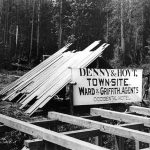
Each neighborhood of Seattle proudly waves the banner of its unique name, and yet many were named in a similar way: by real estate investors. Fremont in Seattle was also named by real estate investors. What made the Seattle neighborhood called Fremont stand out from others, was its good location, its jump-start after Seattle’s Great Fire of 1889, and its vigorous developers who utilized the growing streetcar system to advantage.
Lucas Place

Around Fremont we can find streets with names of early developers of property in the neighborhood. Lucas Place is a street on the east side of Stone Way, closest to North 40th Street.
Lucas Place is in the plat of the Lucas Addition, filed in 1911. A “plat” is an area of land, any size, for which a map of streets and lots has been laid out. The plat info for the Lucas Addition shows that it was filed by the William M.